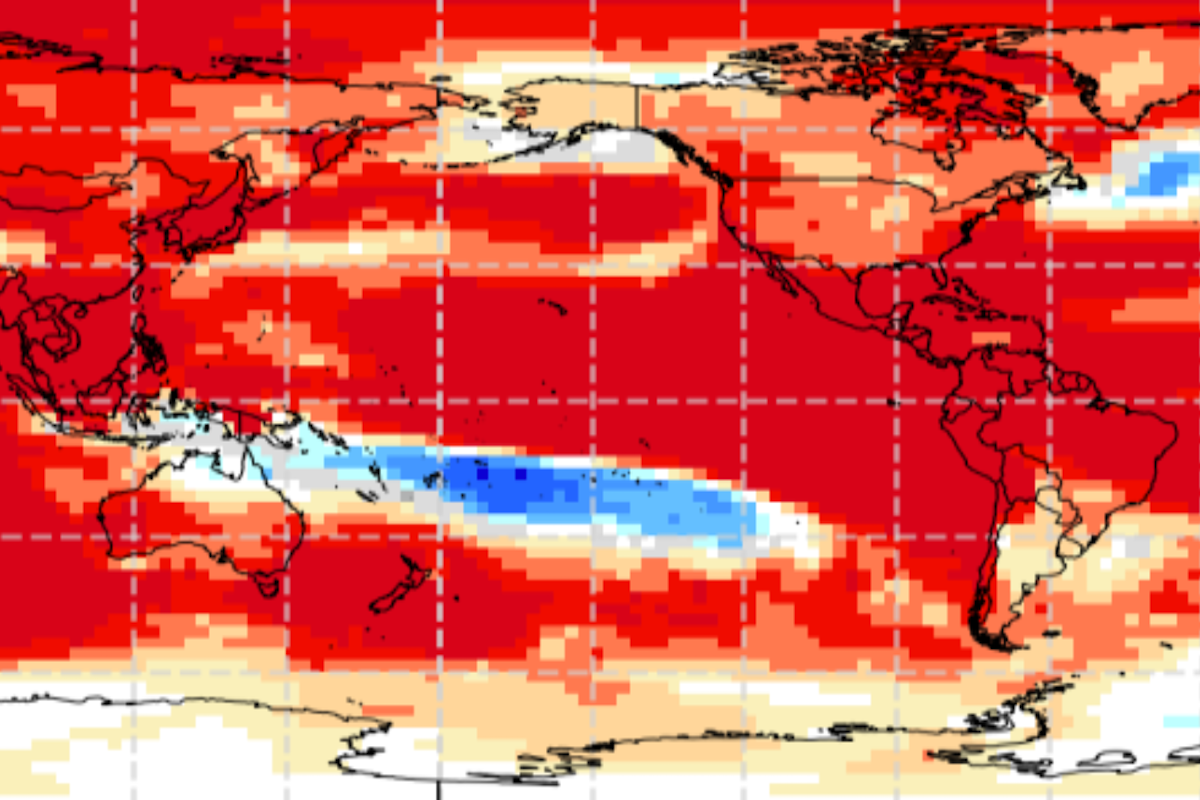
Temperatures forecasted between August and October of this year. Red areas are projected to be far warmer than normal. World Meteorological Organization
El Niño is expected to intensify in the weeks ahead, fueling more severe heat across the globe, according to the U.N. World Meteorological Organization. The forecast comes as blistering heat shatters temperature records from Europe to Asia.
During El Niño, warm waters pool in the eastern Pacific, driving hotter weather around the world, amplifying the impact of warming. El Niño drove record heat in 2023 and 2024, the hottest years ever recorded. This year, forecasters say a strong El Niño will take shape between August and October.
“El Niño is not just on our doorstep — it is inside the house and turning up the heat,” said U.N. Secretary-General António Guterres. “And this is only a warm-up act. El Niño is strengthening — adding fuel to a planet already on fire with scorching heat domes, apocalyptic wildfires, and record hot seas.”
On Sunday, South Korea saw the mercury reach 108.5 degrees F (42.5 degrees C), its highest temperature on record. The South Korean weather agency urged people to “immediately stop all outdoor activities,” warning that even “indoor spaces without air conditioning are dangerous.”
The unprecedented heat came on the heels of a record hot spell in Western Europe, which endured its hottest June on record. France experienced its hottest day ever, while weather stations in Denmark, Germany, and Poland recorded new all-time highs. The heat persisted in July, with Barcelona seeing heat of 105.3 degrees F (40.7 degrees C), the hottest on record.
Hot spells combined with dry conditions to fuel massive wildfires across France, Spain, and now Greece. More than 200,000 people in France were forced to flee their homes in what French President Emmanuel Macron called the worst fire-related crisis since World War II.
In the U.S. last month, scorching heat blanketed much of the country, and Salt Lake City recorded a temperature of 109 degrees F (42.8 degrees C), its highest on record. Climate scientist Brian Brettschneider, of the University of Alaska Fairbanks, said, “It’s going to be a close call, but it now appears more likely than not that July 2026 will be the warmest month on record in the Contiguous U.S.”
ALSO ON YALE E360
Overshoot: The World Is Hitting Point of No Return on Climate