
A plan to map India’s grasslands “signals an important shift in government thinking about these ecosystems,” says a researcher.
And in an important policy move, India’s National Board for Wildlife in April directed government agencies to map, for the first time, the extent and biodiversity of these ecosystems nationwide. The findings will eventually be published in an “Atlas of Grasslands,” with a view to creating a national policy framework to protect and manage these lands. “It’s a long overdue recognition,” says Abi Vanak, an advisor to the Grasslands Trust and the director of the Centre for Policy Design at the Ashoka Trust for Research in Ecology and the Environment. “[The move] signals an important shift in government thinking about these ecosystems.”
The shift is not restricted to India. International attention on grasslands and other scrub landscapes has grown in recent years. A key policy moment, says Chetan Kumar, global head of forests and grasslands at the International Union for Conservation of Nature (IUCN), was the publication of the United Nations’ 2024 Global Land Outlook report, which highlighted the untapped potential of rangelands and pastoralism to bolster climate resilience, biodiversity, and rural development. This year is also the U.N. International Year of Rangelands and Pastoralists — an attempt, says Susan Gardner, director of the ecosystems division of the U.N. Environment Programme (UNEP), to “recognize rangelands as core infrastructure… and to recognize pastoralists as essential partners in protecting, managing, and restoring them.”
In the northern Great Plains of the United States, the National Audubon Society has restored more than 20,000 acres of grassland through a program that works with farmers and ranchers. In Kazakhstan, the Altyn Dala Conservation Initiative has helped protect around 12 million acres of grassland across the Central Asian steppe, increased the population of native saiga antelope, and reintroduced wild horses. Between 2021 and 2025, China restored an average of about 7.7 million acres of degraded grassland each year.

A herder grazes his sheep in the state of Rajasthan. Sandeep Bisht / Alamy
Savannas, steppes, grasslands, and scrub are open lands marked by grass or shrubby vegetation and sparse tree cover. These ecosystems may look desolate, but they contain extensive root systems that stabilize soil, increase rainwater infiltration, and store carbon long term. These habitats are also vital for migratory birds, native bees and butterflies, and diverse wildlife. Many of these landscapes also function as rangelands, supporting livestock and pastoralist communities. According to the UNEP, these lands cover more than half of Earth’s surface, support 2 billion people, provide 16 percent of global food production, and store up to 30 percent of terrestrial carbon.
Yet their importance has not, until recently, been reflected in policy or investment, says Gardner. Much of this landscape has already been lost to farming, industry, and invasive species. The U.S. has lost more than half its historic prairies, primarily to industrial agriculture. India has seen its grasslands shrink from roughly 110 million acres in 1880 to 60 million in 2010, according to one estimate.
In India, this loss has historical causes. Conservation policy has historically focused on forests, in part due to a legacy of colonialism. British officials in India viewed forests primarily in economic terms, as resources that could be converted to timber plantations and cropland or conserved for game animals. Vanak, of the Ashoka Trust, argues that the British recognized savannas as distinct ecosystems in Africa but not in India partly because India’s large game animals, especially its tigers, were concentrated in forests. Apart from the cheetah, which was hunted to extinction, grassland species like wolves weren’t as valued.
Scientists once believed that India had no natural savannas and that grassy or shrubby areas were merely deforested land.
The British classified many grasslands as forests, where grazing was prohibited, while others were labeled as degraded forests or “wastelands,” making them easier to convert to other uses. More recently, says Gardner, farming has shaped assumptions about what “productive” or well-managed land should look like, privileging stationary agriculture over pastoralism.
The wasteland classification persisted in independent India. For a long time, scientists continued to believe India had no natural savannas and that grassy or shrubby areas were merely deforested land. But paleoclimate research has shown otherwise: A 2021 study of lake sediment in western India found evidence that a weakening monsoon 6,000 years ago drove the expansion of savannas in peninsular India.
Misperceptions about baseline conditions have made some areas vulnerable to change. In the 1980s, the government set up a National Wasteland Development Board with the aim of turning these lands to “productive use,” promoting their conversion to farming, plantations, and other uses.
A 2023 study led by Vanak found that less than 5 percent of India’s semi-arid open natural ecosystems are protected — and that nearly 70 percent of those open systems overlapped with officially designated wastelands. More recently, these seemingly empty landscapes have been targeted for solar and wind power projects — to the detriment of local wildlife and pastoralists — as well as for more tree plantations. In 2024, a new policy opened degraded land, including scrubland and pasture commons, to private plantations for the generation of carbon credits or to fulfill national afforestation goals.


Left to right: An Indian gazelle, Indian wolf, and Indian courser. All three species have been harmed by the loss of grasslands. The Grasslands Trust; Tisha Mukherjee via Wikipedia; Rushikesh Deshmukh via Wikipedia
Conservationists hope that the new effort to map grasslands will help avert further losses. The official Atlas project is still in early stages: Since the April directive, the government-funded Wildlife Institute of India has put together a comprehensive plan, in partnership with two other forest research agencies, to map existing grasslands, document biodiversity, and highlight areas under threat. Based on the findings, agencies will suggest restoration and management strategies, according to a government researcher with knowledge of the project.
State governments are also beginning to shift their approach to land use. In May, the state of Maharashtra issued guidelines for afforestation that recognized grasslands as distinct ecosystems that need locally tailored restoration, rather than blanket tree plantation. “Government attitudes are slowly changing,” says Godbole of the Grasslands Trust. “But things need to move faster on the ground.”
The challenges of conservation are apparent on the newly widened road to Gulunche. The restoration site lies less than 60 miles southeast of Pune, a once-small town that has tripled in size over the past three decades. The semi-arid landscape is a patchwork of privately owned farms, state-owned forest land, and commons, known as “gairans,” which are also state-owned. An irrigation scheme introduced 10 years ago helped expand the farming of sugarcane, a water-intensive cash crop. With an international airport planned in the area, land prices have risen and owners have begun to fence off their plots, blocking the passage of sheep and wild deer.
Some of India’s fastest-declining birds are scrubland species that don’t perch on trees.
As Pune’s native habitat has shrunk, so has its wildlife. Some of India’s fastest-declining bird species, according to the IUCN Red List, are scrubland species that don’t perch on trees. Populations of the Indian courser, for example, have declined by more than 70 percent due to habitat loss. Gazelle numbers have also declined, and Indian gray wolves survive in these habitats partly by feeding on waste dumped by poultry farms, says Godbole. One major conservation challenge, notes his colleague and cofounder Vishwatej Pawar, is that “the species is protected but the habitat is not.”
Local and nomadic pastoralists, who graze their flocks of sheep on this open land, have also been affected by habitat loss. Sadashiv Mote, a local shepherd, says he’s reduced his flock because farms, buildings, and fences have taken over grazing land. “Water is also scarcer now,” he says as he herds his roughly 100 sheep toward a patch along the highway where he spotted new grass growing.
While pastoralists have traditional rights on grazing commons — according to one estimate, India has some 13 million practicing pastoralists — the practice has often been viewed by economists as inefficient and by conservationists as environmentally destructive, says the UNEP’s Gardner. But such attitudes are starting to change. Last year, for the very first time, India’s five-year livestock census counted the animals held by nomadic pastoralists, not just animals on farms — a sign of expanding recognition for pastoralists. “The shepherd is as much a part of the grassland landscape as the wolf,” says Godbole.

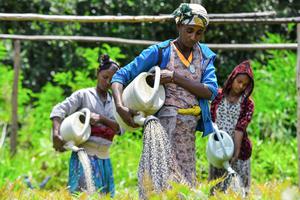
Locals plant native grasses at a restoration site in the village of Gulunche. The Grasslands Trust
That philosophy underpins the work of the Grasslands Trust, which partners with local communities as well as the forest department. The Gulunche restoration site sits on commons land where, with the consent of the village, grazing is temporarily banned. “We were not using the area much, and we wanted to support a project that could benefit us,” says Samradnee Nigade, the young head of the village council. Those benefits include employment for locals and the production of a high-quality fodder made of fermented native grasses, sugarcane, and corn, as well as biochar made from invasive trees removed from the site. The trust is also figuring out how to revive ancient water courses that may have shrunk due to human activities.
The challenges at Gulunche mirror those of larger restoration projects. Scientists know much less about restoring grasslands than conserving forests — one review found that 89 of the 206 endemic Indian savanna species had been described only in the last two decades. Traditional knowledge is critical for managing many of these landscapes, says the IUCN’s Kumar, but research is especially important in areas changing rapidly due to development and climate change. Unfortunately, conservationists say, funding to run restoration experiments is not nearly as abundant as funding for forests, in part because donors prefer to support projects with highly visible outcomes.
“We need to provide alternative models to afforestation for dryland areas,” Vanak says. It shouldn’t be that hard: As Godbole likes to point out, trees are difficult to grow in dry landscapes. Grassland restoration, he says, “is cheaper and more ecologically responsible.”


_-_cropped.jpg)