“Our calculations suggest we might harvest krill to the point where we do real damage to recovering whale populations.”
Now another possible threat to krill populations is worrying researchers and conservationists. The crustacean’s massive concentrations in the Antarctic have attracted supertrawlers from around the world that vacuum up to 1,000 tons of krill a day, then process the animals onboard into krill oil. Rich in omega-3 fatty acids, the oil is used in human nutritional supplements, as food for aquaculture, and in pet food.
Thanks to technology that allows large-scale harvesting, the business began to take off about 15 years ago and is now booming. Last October, Norway began lobbying the Commission for the Conservation of Antarctic Marine Living Resources (CCAMLR), which manages the krill fishery, to double the allowable take in the Southern Ocean. The krill industry is worth as much as $900 million annually.
But there is growing alarm among researchers and conservationists about what the harvest could mean for whales, in addition to imperiled seals and penguins. Earlier this year, the European Union passed a resolution calling for a five-year moratorium on all krill fishing in the Southern Ocean as a precaution while more data are gathered.
“Our calculations suggest an alarming possibility that we might harvest krill to the point where we do real damage to recovering whale populations,” said Matthew Savoca, a whale researcher at Stanford University and the coauthor of a recent study that addressed this issue.

Blue whales are the largest animals on Earth. eco2drew / iStock
Nowhere on the planet do krill — considered the most abundant wild animal species in the world, as measured by biomass — occur in higher numbers than in Antarctica. A keystone species in the Southern Ocean ecosystem, krill are an essential food for other baleen whales, seals, penguins, and a variety of birds. Populations of the crustaceans are especially dense in the Scotia Sea, which stretches between the Antarctic Peninsula and the South Orkney Islands; estimates vary widely, but the area may contain as much as half of the global population.
Not surprisingly, this is also a place where whales aggregate. Savoca recently returned from a research trip to Antarctica and said he was bowled over by the number of cetaceans in a small area. “This is Serengeti-migration-level stuff,” he said. “It’s a full-on sensory experience. You are surrounded by blows,” or whales spouting. “You see the blows, hear the blows, and you smell the blows because it’s kind of stinky. It smells like rotting cabbage.”
Such mass whale gatherings are largely the result of an international moratorium on whaling that went into effect in 1986, allowing baleen whales — fin, humpback, sei, minke, and right whales — to stage a remarkable comeback. The super-abundance of krill in the region has also contributed to their climb back to healthy population levels. Blue whales feed here, too, though they remain listed as endangered, with their population 95 percent lower than in pre-whaling days.
Calls for restrictions on the krill industry are growing louder among scientists, activists, and some politicians.
Thanks to the growing demand for krill oil spurred by health-conscious consumers, as well as the proliferation of fish farms, supertrawlers as long as football fields now work the same space as krill-eating whales. The trawlers use echo sounders, a type of sonar, and even drones to find massive swarms of krill. Some fishers use fine mesh nets to bring them aboard; Aker Qrill, part of Aker Biomarine, the Norwegian company that takes almost two-thirds of the total Antarctic krill quota of 620,000 tons, uses a method called continuous pumping, in which a hose inserted into a krill swarm vacuums crustaceans onto the deck of the ship for immediate onboard processing.
A number of studies have established that climate change, which is driving a decline in sea ice, is affecting the resilience of krill, which are in some regions in steep decline. “Krill are very reliant on ice,” said Savoca. “When krill are young, they need to hide under the ice from predators, and they eat algae off the underside of the sea ice. And if there is less ice, both in extent and duration, they don’t recruit as well.”
Whales are difficult to study in the extreme environment of Antarctica, but one recent study showed that the decline in the availability of krill can lead to fewer pregnancies and reduce viability in humpback whales. Other krill-consuming species that are more accessible to researchers have been studied as a proxy. The Antarctic fur seal and the emperor penguin were recently added to the IUCN endangered list because of their falling populations, due in part to a decline in prey driven by climatic changes and to krill shortages.
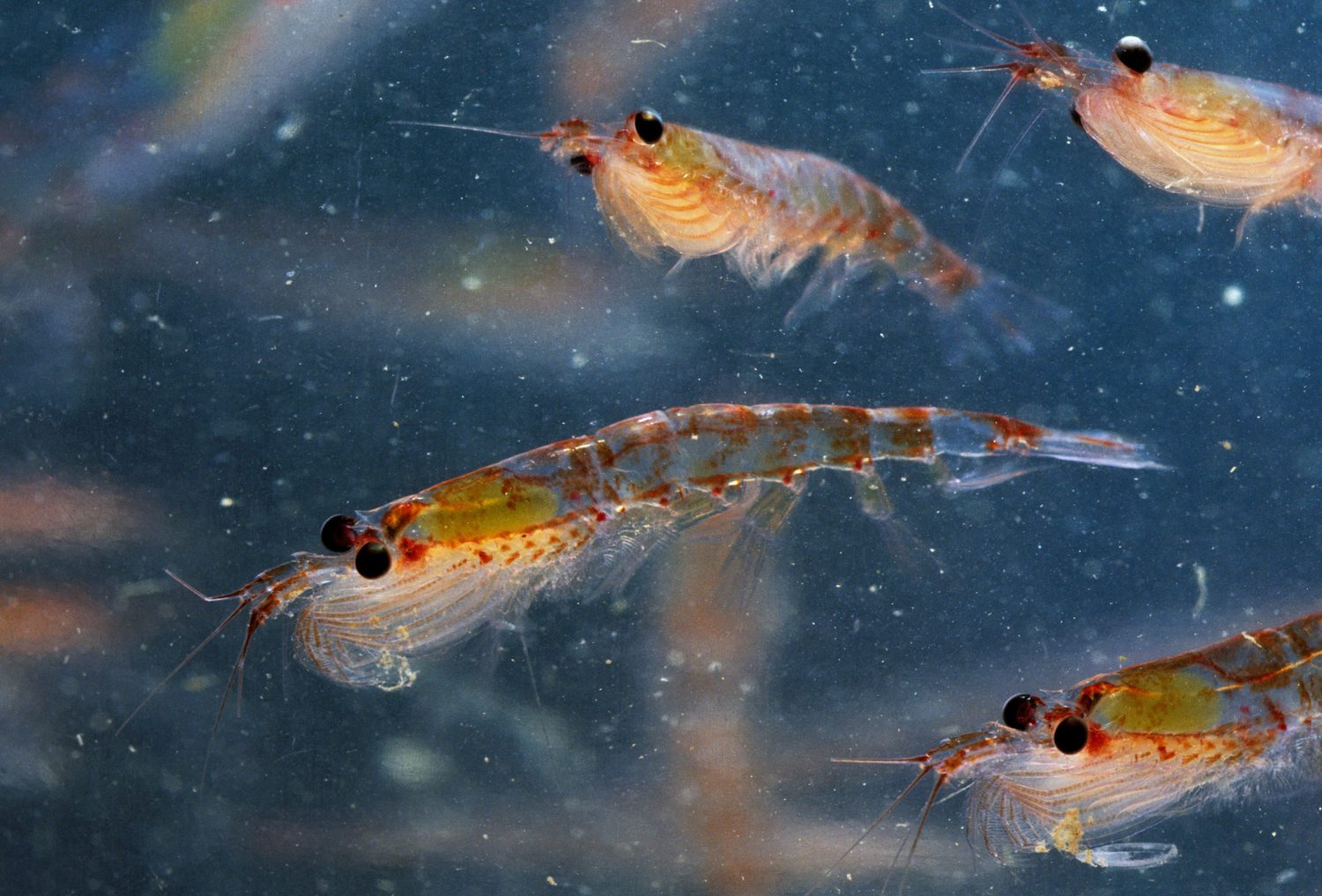
Antarctic krill. David Tipling / Alamy
This year the limit on krill was reached three months early in the year-round season, in part because the industry has grown and in part because trawlers were not bound by spatial distribution rules and so concentrated their efforts in krill hotspots. This is the first time the quota has been met so early, and it spurred some of the 27 nations in the CCAMLR to call for expanding the limit.
Opponents of expansion argue the CCAMLR is obliged by its bylaws to abide by the precautionary principle, which states that in the absence of definitive science, management should be cautious. But a recent study found that krill fishery managers were not taking into consideration the synergistic effects of krill fishing and rapid climate warming on penguins — factors that researchers say likely affect whales too.
“Given the existential threat to the Antarctic ecosystem that climate change poses, we should not be adding other risk factors,” said Peter Hammarstedt, the chief campaigns officer for Sea Shepherd Global, which lobbies to end the krill fishery. “We need to remove all other risk factors to create ecological resilience. That’s why it’s troubling the krill fishing is expanding.”
Calls for restrictions on the krill industry are growing louder among scientists, activists, and some politicians. And while the E.U.’s passage of the resolution calling for a five-year moratorium on krill fishing in the Southern Ocean was a symbolic victory for conservationists — there are no E.U. countries that fish for krill — an actual ban cannot go into effect without the unanimous approval of the CCAMLR.
Two large drugstore chains in Germany and a large chain of stores in the U.K. are committed to phasing out krill oil products.
Meanwhile, a battle over the term “sustainable” rages. In 2010 the fishery was first certified as sustainable by the Marine Stewardship Council (MSC), an international nonprofit that monitors and certifies wild fisheries, and it has since been recertified several times, including this year.
Because the requirement that krill fishing be spatially distributed lapsed in 2024, the fishing trawlers concentrated their catch where populations are densest — and where the most whales and other wildlife are present. These are also areas most affected by climate change. Earlier this year, the World Wildlife Fund called on the MSC to remove its sustainable designation.
“Antarctic krill are the powerhouse of the Southern Ocean,” said Rhona Kent, polar oceans program manager at WWF-UK, “and mismanagement of the krill fishery is having a major negative impact on species which depend on krill,” including whales. To protect those species and their ecosystems, “WWF is calling for an immediate moratorium on krill fishing and a review of the sustainability certification issued by the MSC.”
For its part, the industry argues that it operates with the best available science in a sustainable manner, taking only 1 percent of the total Antarctic population. “CCAMLR has been trying to move from 620,000 tons to a more science-based quota,” said Pål Skogrand, chief policy officer for Aker Qrill. “And the science says it could definitely be doubled.”

Emperor penguins depend on Antarctic krill for their survival. Wolfgang Kaehler / LightRocket via Getty Images
Chile and Argentina, members of the CCAMLR, have repeatedly introduced proposals to establish a Marine Protected Area for portions of the Scotia Sea, including the South Orkney Islands and the Antarctic Peninsula, but there have been years of disagreements over boundaries and restrictions on krill fishing. Again, it takes a unanimous council to pass resolutions, and both China and Russia have opposed this measure. The Norwegians have said they would support an MPA if the overall catch was doubled.
Other groups aren’t waiting for consensus. In April, allies of anti-whaling activist Paul Watson, who founded the Sea Shepherd Conservation Society and now operates the Paul Watson Foundation, steered the foundation’s ship into a krill fishing vessel owned by Aker Qrill. Damage was slight; the company said it is pursuing an investigation.
Sea Shepherd Global, a separate organization, takes scientists and journalists to monitor and raise awareness of the krill fishery; it’s also spearheading a media campaign that asks retailers to stop carrying krill oil supplements in favor of stocking plant-based omega-3s. Hammarstedt says that two large drugstore chains in Germany — a large market for krill oil supplements — and a large chain of stores in the U.K. that sell nutritional supplements are committed to phasing out krill oil products. Some two-thirds of the value of krill is in oil for supplements, and if they were no longer made, Hammarstedt said, “it would absolutely end this fishery.”
As the pressure on this industry increases, there remain more questions than answers. “You have a fragile system that is pushed to the brink with climate change,” said Savoca. “Does it make sense to fish for krill and add another threat? And if we do, how can we do it in a way that is smart and cautious?”