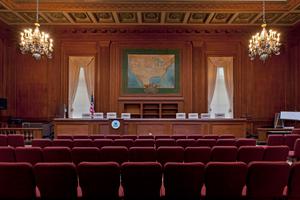
In April 2024, Tish Taylor and her father, Robert, stood behind President Joe Biden’s Environmental Protection Agency chief, Michael Regan, as he signed a regulation designed to dramatically reduce toxic pollution from petrochemical plants like those that cluster near the Taylors’ homes along the lower Mississippi River, in Louisiana.
Taylor struggled not to cry through the signing ceremony, which followed years of demands from communities like hers — in the 85-mile corridor between New Orleans and Baton Rouge that has become known as Cancer Alley — for tighter limits on plants’ emissions. The new regulation, known as the HON rule, was “a wonderful gift to generations ahead of us,” Taylor said. “It’s hard for me to find the words to say how validated we felt.”
For decades, regulations on emissions of hazardous chemicals such as toluene, ethylene oxide, and vinyl chloride have been weaker than restrictions on more common pollutants, such as those emitted by vehicles.
The Biden administration took major steps to strengthen Clean Air Act rules on those hazardous air pollutants, and the HON rule was a centerpiece of that effort. Toughening requirements on six different pollutants at more than 200 petrochemical plants, it was one of a slate of regulations the Biden administration enacted on air toxics, each covering a specific industry, from steelmaking to tire manufacturing.
All nine air toxics rules issued by the Biden administration have been rescinded, revised, or reconsidered.
But shortly after President Donald Trump began his second term, his administration began unraveling those rules, including the one the Taylors had so recently celebrated. Last year, Trump granted two-year exemptions from the HON rule to more than 50 petrochemical facilities. This July, he issued 20 more temporary exemptions, and the EPA said it would propose a rewrite of the regulation this fall. The new version is all but certain to significantly scale back the rule’s protections.
“Everything that the Biden administration did to help protect us was pretty much just thrown in the garbage,” Tish Taylor said in July, and replaced by “a death sentence.” St. John the Baptist Parish, where her family lives, has the country’s highest risk of cancer from air pollution — nearly 50 times the national average. A disproportionate percentage of those exposed to the highest levels of pollution in the region are Black.
A set of amendments to several existing regulations on toxic air pollutants, the HON rule — which stands for Hazardous Organic National Emission Standards for Hazardous Air Pollutants — requires petrochemical plants to upgrade their pollution control equipment to reduce emissions of two hazardous chemicals: ethylene oxide and chloroprene. It also mandates air monitors at plants’ fencelines to measure concentrations of those chemicals and four more — benzene, ethylene dichloride, vinyl chloride, and 1,3-butadiene — and requires operators to carry out necessary repairs if emissions exceed limits.
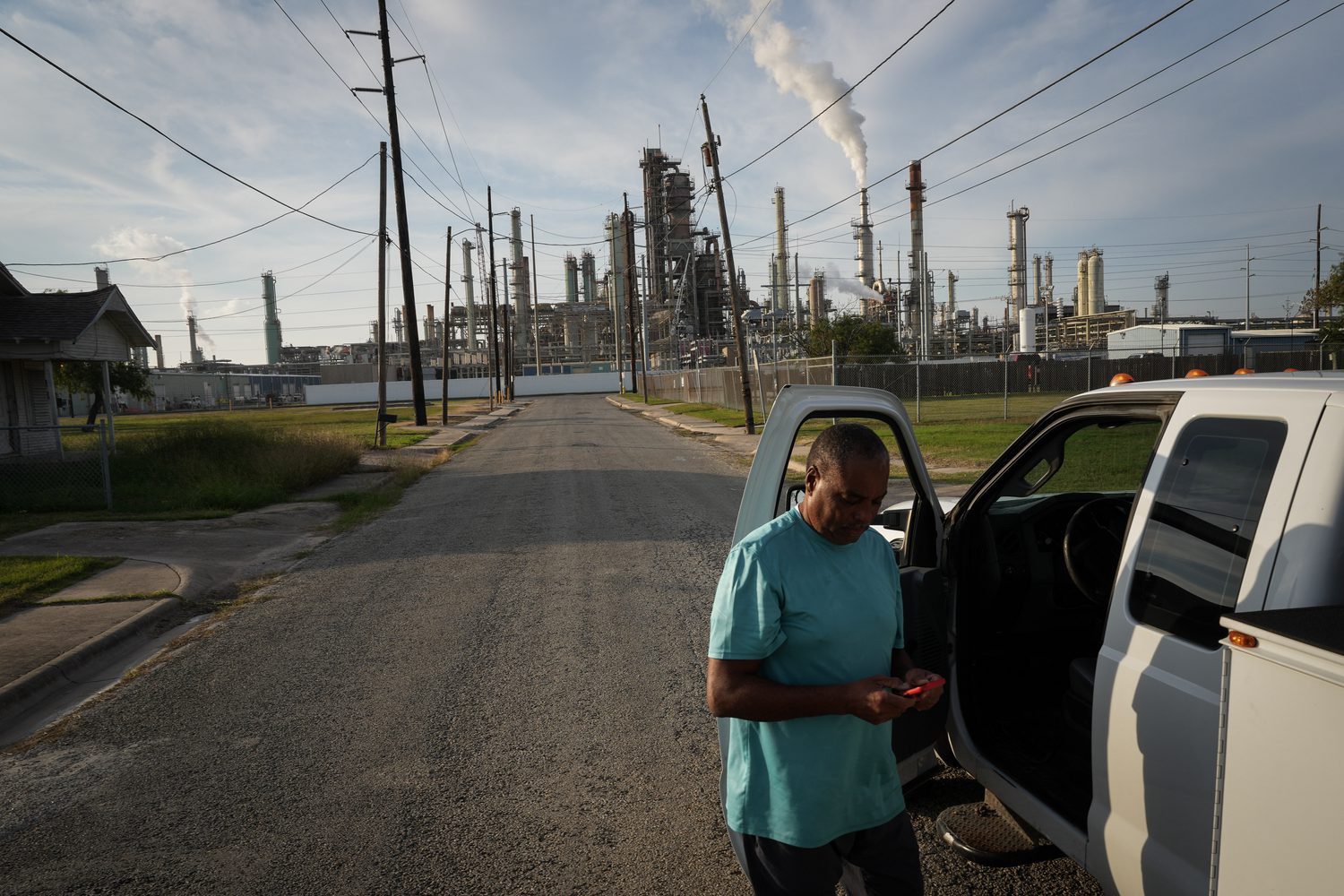
Hillcrest, a predominantly Black and Latino neighborhood in Corpus Christi, Texas, that is surrounded by petrochemical plants. One such facility was granted a two-year exemption from the HON rule. Jon Shapley / Houston Chronicle via Getty Images
Tracey Woodruff, a Stanford University epidemiology and population health professor who formerly worked on toxic assessments at the EPA, said the pollutants covered by the HON rule are “the classic bad guys of toxic chemicals,” compounds that raise risks for breast cancer, liver cancer, leukemia, lymphoma, and reproductive problems. “We’ve known about their toxicity for decades,” she said, and “they should have been more highly regulated a long time ago.”
The HON rule also closed a long-standing loophole that freed plants from emissions requirements when they were shutting down and starting up — for example when carrying out maintenance, or ahead of a storm. With climate change fueling more extreme weather, that loophole has “a massive impact on what is actually getting released,” said Shiv Srivastava, policy director at Fenceline Watch, a Houston environmental justice group.
The HON rule was one of nine new air toxics rules issued by the Biden administration. The eight other rules targeted emissions from sectors including iron- and steelmaking, copper smelting, tire manufacturing, and coal-fired power plants. All nine have been or are now being rescinded, revised, or reconsidered.
Under Trump, the EPA has invited companies to request exemptions from hazardous pollutant regulations.
The HON rule was among the most wide-reaching of those hazardous pollutant regulations. “This is a big rule,” said Joe Goffman, who headed the EPA’s air office under Biden. Because air toxics rules typically address very specific types of industrial facilities, an individual regulation sometimes applies to only a handful of plants in a few locations, with pollution reductions often measured in just hundreds of pounds, he said. But the HON rule covered approximately 220 large petrochemical plants, so its footprint promised to be both bigger and more wide-reaching geographically. Nearly 60 percent of the facilities it covered are in Texas and Louisiana, home to the nation’s largest petrochemical production zones. The rest are scattered across the country, in states including Tennessee, Kentucky, West Virginia, Ohio, Illinois, and Alabama.
The EPA estimated when the rule was finalized that it would prevent 6,200 tons of toxic air pollution annually, and slash emissions of ethylene oxide and chloroprene from the plants it regulates by almost 80 percent. In communities near HON plants, the agency said the regulation would reduce the risk of cancers related to air toxics by 96 percent. Facilities affected by the rule produce ingredients for common products such as plastics, paints, antifreeze, and cleaning and personal care items like detergent and shampoo.
Weeks into Trump’s second term, the EPA invited companies to email the agency with requests for exemptions from the HON rule and Biden’s other hazardous pollutant regulations. In granting the postponements, Trump invoked a Clean Air Act provision that environmental lawyers say has never been used: allowing temporary exemptions to emissions rules if they are “in the country’s national security interests” and if the technology required to comply with a regulation is unavailable.
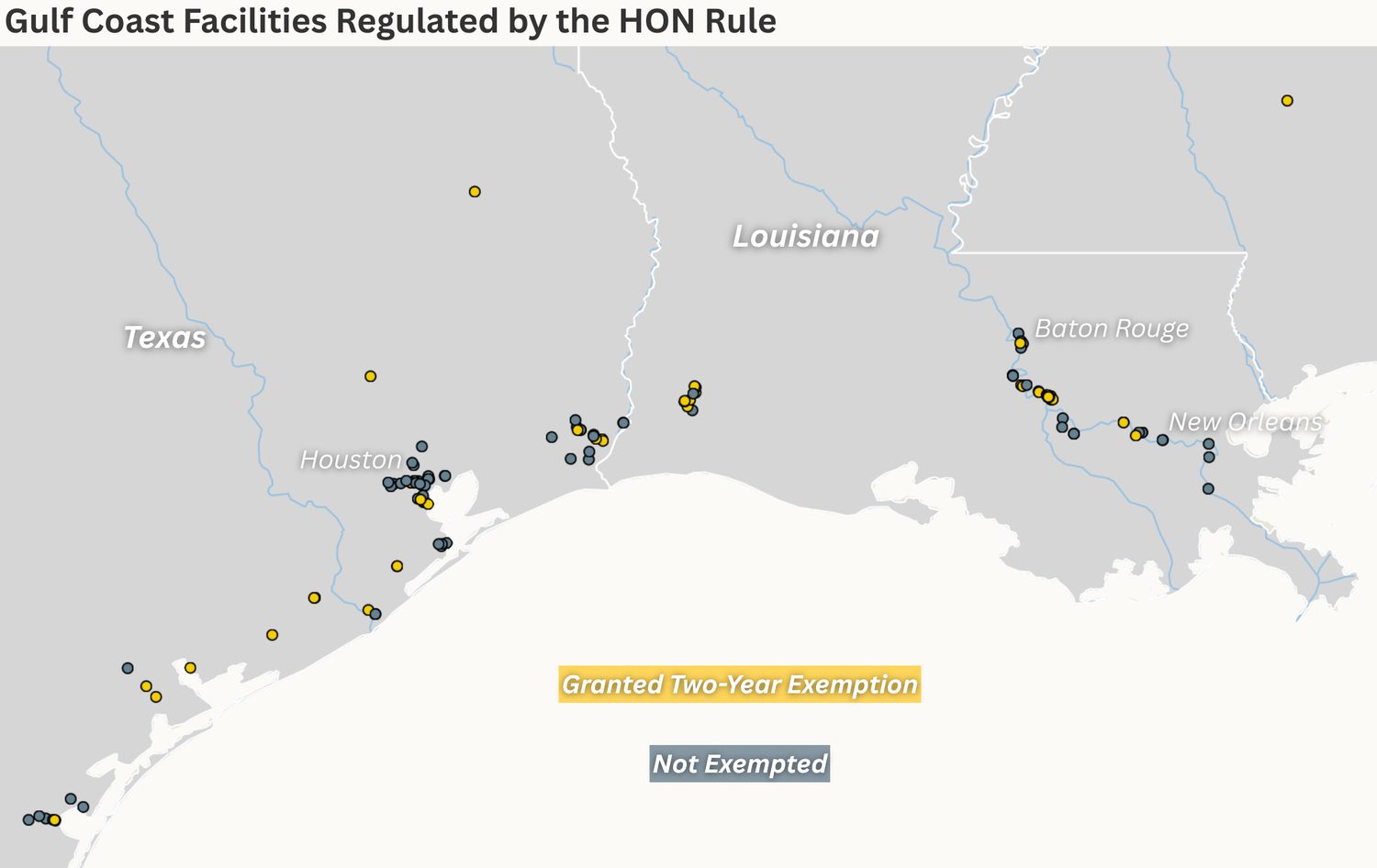
Gulf Coast petrochemical plants regulated by the 2024 HON rule. Source: Environmental Defense Fund. Yale Environment 360
“The HON Rule imposes substantial burdens on chemical manufacturers already operating under stringent regulations,” Trump’s exemption proclamations said. “Maintaining a robust domestic chemical industry is vital to safeguarding the supply chains that underpin our economy and to reducing the Nation’s dependence on foreign control over materials critical to national resilience.”
Trump’s orders provided no evidence for their assertions. “That’s not how this works,” said Annie Fox, a staff attorney at the Clean Air Council, in Philadelphia. The law requires a president to set out specifics supporting each claim made in justifying an exemption, “not just state it,” she said. “These are supposed to be rare exceptions that are well-grounded in research and facts.”
Last October, a coalition of local and national advocacy groups, including the Taylors’ Concerned Citizens of St. John, sued Trump and his EPA in the U.S. District Court for the District of Columbia over the exemptions, arguing that Trump’s claims are false and amount to “a pretext to relieve polluters from working to comply” with the HON rule while the administration works to undo the regulation.
The American Chemistry Council, a trade group representing petrochemical producers, said the exemptions “offer a pathway for relief for some sources from some of the unrealistic timelines” in the HON rule. It called the regulation “overly stringent” and said it “exceeds the EPA’s statutory authority, disregards relevant scientific evidence, and imposes some requirements without technological availability.”
Nationally, there were 131 industrial accidents resulting in reportable chemical releases last year.
The EPA said in an emailed statement that all its proposals on air toxics aimed to “protect American industry and supply chains, while still minimizing Americans’ unnecessary exposure to hazardous air pollutants.”
The HON rule’s roots lay in a 2016 reevaluation of ethylene oxide gas that revealed it was much more dangerous to those inhaling it than had been previously understood. That reevaluation also led, in 2024, to a regulation that tightened emissions limits on ethylene oxide at facilities that use it to sterilize medical equipment.
In March, the EPA proposed replacing the medical sterilizer rule with a weakened version, arguing that the Clean Air Act gives regulators very limited scope to update rules in accordance with new science on health dangers.
In backtracking on efforts to limit exposure to hazardous air pollutants, Woodruff said, the Trump administration has signaled that “whatever the industry wants to do, that’s what we want to do.” She noted that former fossil fuel and petrochemical industry representatives hold top jobs across the EPA. The policy changes “will lead to people getting sicker and dying,” she said. “This is exactly opposite of what this administration claimed they wanted to do in terms of ‘Make America Healthy Again.’”

A 2023 fire at a Shell petrochemical plant in Houston. The plant was recently granted a two-year exemption from the HON rule. Raquel Natalicchio / Houston Chronicle via AP
HON rule exemptions are not the only change that will increase risks to Americans living near petrochemical facilities, advocates say. The EPA has also proposed undoing changes the Biden administration made to strengthen a safety rule called the Risk Management Program, which empowered workers dealing with hazardous substances to stop operations they believe to be dangerous, and required chemical facilities to prepare for natural disasters, undergo independent audits after accidents, and share information with the public.
Nationally, there were 131 accidents resulting in reportable chemical releases last year. For those living near the Houston area’s nearly 700 chemical plants, “there are constant explosions, there are constant fires, there are constant black, dark plumes that linger over our communities,” Srivastava said.
The Biden-era update sought to address such dangers, but the Trump administration said the new rule was too costly and burdensome, and that it had made refineries and chemical facilities “less safe and less competitive.” Many of the plants it covered already had effective safety programs, the EPA said in a statement, and eliminating duplicative requirements would enable operators to focus on the most important changes. “Due to the varied, complex nature of chemical facilities, the facility operator is in the best position to assess risks and identify steps to mitigate these risks,” it said.
Last year, the administration also removed an online data tool the Biden administration had created to give communities located near petrochemical plants information about their operations, including their accident history, emergency response plans, and the chemicals they handle. Srivastava said the tool’s loss cuts off neighbors’ access to even the most basic information about nearby plants — their names and locations, for example — making it hard for communities to even begin preparing for accidents. And easing safety mandates, he said, “makes us extremely, extremely vulnerable to having a massive, catastrophic disaster on the scale of something like what happened in Bhopal,” where a leak at a Union Carbide pesticide plant, in India, killed thousands of people in 1984.
Sharon Lavigne, founder of RISE St. James Louisiana, an advocacy group in “Cancer Alley,” still has the pen that the EPA’s Michael Regan gave her after he signed the HON rule, and her group is a plaintiff in the lawsuit challenging Trump’s exemptions. She said she believes the president’s disregard for the regulation reflects his belief that “we are nothing,” and she vowed to continue fighting to restore the HON rule’s original reach and strength. “When he gets out of office,” she said, “we’re gonna fix it back.”