An estimated 82 percent of the world’s oceans are currently experiencing marine heat waves.
Globally, marine heat waves — prolonged periods of unusually warm water — are becoming more common, more intense, longer lasting, and more widespread, experts say. This year, ocean heat is unusually severe, setting new temperature records. According to Global Climate Risks, a nonprofit created by scientists to publicize the effects of climate change, an estimated 82 percent of the world’s oceans are currently experiencing marine heat waves. Evidence from recent hot spells suggests the impacts on sea life could be profound and long-lasting.
Ocean fevers can rearrange marine ecosystems, drive fish to move into deeper, colder layers of the sea, trigger coral bleaching, and cause widespread marine die-offs. They can increase the severity and number of algal blooms, which harm fish, shellfish, marine mammals, and birds. And they can cause extreme weather events, like tropical storms and hurricanes, and upend fishing and tourism.
To officially be called a heat wave, temperatures must rise above the 90th percentile of normal seasonal variation for five consecutive days. While marine heat waves do occur naturally, climate scientists say anthropogenic warming has exacerbated them. According to NOAA scientists, oceans have absorbed more than 90 percent of the excess heat produced by human-caused global warming. One recent study found that, since 1940, warming has led to a threefold increase in the number of days per year with extreme heat at the ocean surface.

Marine heat waves in August. Warmer colors indicate greater severity. NOAA
Climate warming and marine heat waves are separate phenomena with different effects. Ocean warming is gradual and allows more time for species to adapt and evolve. Marine heat waves are acute and produce rapid and extreme changes that give organisms little time to adapt. But the long-term warming trend is making ocean heat more severe.
Climate change has raised the temperature of the waters off the U.K. by around 2 degrees F above average in the last six decades, worsening this year’s record heat. Records have fallen elsewhere in Europe as well. “We find it’s the most extreme July marine heat wave conditions for the Western Mediterranean, the Celtic Region, and for the Bay of Biscay and Iberian Peninsula,” said Catherine Gregory, a climate scientist at the University of Bern.
The Pacific has warmed in northern regions by almost 2 degrees F and is currently experiencing the world’s largest marine heat wave, which sprawls over more than 24 million square miles. And in the central and eastern Pacific, things are bound to get worse. This year’s El Niño is expected to be the strongest in living memory — it has already spiked sea temperatures far earlier in the year than expected — and scientists fear it will expand the size and intensity of the two existing marine heat waves off the California coast. Based on studies of past heat waves — in particular, an event known as the Blob, the largest marine heat wave on global record, which dramatically raised temperatures in the eastern Pacific between 2014 and 2016 — scientists are warily watching the warming ocean, anticipating a cascade of severe impacts both onshore and off.
Seabirds in South America have been dying in large numbers, a trend experts say is linked to higher ocean temperatures.
The Blob began to form in the fall of 2013, when a persistent high-pressure ridge greatly reduced the cool winter winds that normally blow over the eastern Pacific. Without that cooling, the sun created a very large body of very warm water. In 2014, ocean temperatures were 7 degrees F above average, and the cold nutrient-rich water that normally coursed along the West Coast disappeared.
The ecological changes were legion. In 2015, researcher Ric Brodeur was monitoring populations of shrimp-like krill, which form the base of the marine food chain, expecting his sampling nets to be full. Instead, they were almost empty. “You could fit all the krill from the trip into a little plastic bag,” he said.
The lack of food caused humpback whale numbers in the North Pacific to drop by an estimated 7,000 — or 20 percent of the population. Many females became emaciated, which reduced calf survival and caused a reproductive decline that didn’t begin to reverse until 2021, five years after the Blob had officially ended.
While many anomalies caused by the unusually warm water were temporary, some were not. The Blob — which at times approached 10 degrees F higher than average — caused large-scale and long-term ecosystem changes, some of which persist to this day. Researchers are concerned that today’s warming waters will compound the damage caused by previous marine heat waves.

A diver surveys bleached corals off the coast of Koh Tao in Thailand, which was hit by a marine heat wave in 2024. Scientists are worried that record ocean heat this year will further harm corals. Lillian Suwanrumpha / AFP via Getty Images
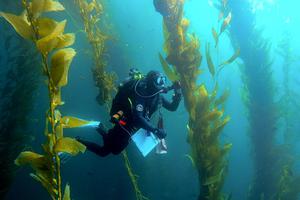
One of the most egregious of those earlier changes was the die-off of kelp forests along thousands of miles of coast, from Baja California to as far north as British Columbia. Kelp complexes are some of the most dynamic and biologically productive ecosystems on Earth, the “underwater rainforests” of temperate and Arctic coastal oceans. They offer food, nursery grounds, and shelter from predators and rough currents to hundreds of marine species. Kelp canopies, which consist of rubbery floating fronds, are home to sea otters, seabirds, and juvenile fish, while abalone, sea urchins, lobsters, and octopus live on or near the seafloor.
“The Pacific kelp forest has lasted for millions of years,” said Melissa Carter, a biological oceanographer with UC San Diego’s Scripps Institution of Oceanography, thanks to upwellings of cold water along the coast. “But it has a specific temperature threshold where it falls apart and it can’t survive. And everything that lives on the coast depends on that ecosystem.”
One study found that during the Blob, overall kelp cover dropped considerably: Northern California was hardest hit, with 95 percent of its kelp wiped out. The loss of kelp reshaped the entire food web, decimating red abalone populations, which were already in trouble, and prompting the state of California to extend its ban on recreational fishing of the species at least until April 2036.
One of the largest algal blooms in history now stretches from Southern California to the coast of British Columbia.
The Blob also severely impacted seabirds. Half of Alaska’s common murres — some 4 million birds — starved to death as warmer currents disrupted migrations of anchovies, sardines, and other forage fish. “Recent population abundance estimates since then have found no evidence of recovery,” the authors of a 2024 study of the murres concluded, “suggesting that the heatwave may have led to an ecosystem shift.”
Current marine heat waves are already taking a toll. Dead and dying birds, including California brown pelicans, loons, and grebes, are turning up again on Southern California beaches. “We’re seeing cormorants walk to shore and then just die within the hour,” Tammy Russell, a researcher at the Scripps Institution of Oceanography, told the Associated Press, “and we’re seeing it happening across the whole coast.” Seabirds along South America’s Pacific coast have been dying in large numbers in recent months, and experts have linked the fatalities to higher ocean temperatures.
Researchers are concerned that current record-setting ocean temperatures, intensified by the strengthening El Niño, will further harm corals. Bleaching occurs when rising water temperatures, in addition to other stressors like pollution and overexposure to sunlight, spur corals to release their symbiotic algae, which harvest energy for them. A bleaching event that lasted from early 2023 until mid-2025 affected more than 84 percent of the world’s coral reef areas. In a major report that was just released, Global Coral Reef Monitoring Network researchers warn that coral reefs around the world are seeing a rapid increase in bleaching and that recovery windows between disturbance events are narrowing.

Veterinarian Jennifer Russell treats an ailing pelican at SeaWorld in San Diego. Rehabilitation centers have cared for hundreds of emaciated seabirds amid a marine heat wave in Southern California. Gregory Bull / AP Photo
Marine heat waves can affect conditions throughout the water column. When a cap of warm water forms at the ocean’s surface, it prevents vertical mixing and can promote the growth of harmful algal species. The explosion of aquatic organisms depletes oxygen in the water, blocks sunlight, and can release harmful toxins into the air and water.
One of the largest algal blooms in history now stretches from Southern California to the coast of British Columbia. The bloom is dominated by an alga called Pseudo-nitzschia, which multiplies faster and becomes more toxic in warmer water. The alga produces a neurotoxin called domoic acid that is responsible for killing hundreds of California’s sea lions, whales, and porpoises.
It is a perilous moment for the world’s oceans as temperatures hit levels never seen in modern times. And scientists fear the impacts of earlier warming events are only a prologue for what lies ahead.
“The Blob was extreme, the warmest we’ve ever seen anything in 110 years,” said Carter, of Scripps. “We are definitely along the same trend now, and the number of marine heat wave days we’ve [already] seen are exactly on par with 2015. This is a new Blob.”